
Search smallrig.com...


CPL vs ND Filter: What's the Difference and When to Use Each
SmallRig 2026-05-06 21:13:38
Contents
Every photographer eventually asks this question: "Do I need a CPL or an ND filter?" The answer is — it depends on the problem you're trying to solve.

What Problems Do CPL and ND Filters Solve?
CPL (Circular Polarizing Filter) and ND (Neutral Density Filter) are two completely different tools designed to solve distinct shooting problems.
CPL: Selective Polarized Reflection Reduction

A CPL filter consists of two layers of glass, with the outer ring rotatable. By adjusting the rotation angle, a CPL can:
-
Eliminate directional polarized glare on non-metallic surfaces, such as light flares, water surface reflections, and glass reflections
-
Darken the sky and add depth and dimension to cloud layers
-
Boost color saturation to make the sky bluer and foliage more vibrant
Working Principle: Reflections on non-metallic surfaces produce directional polarized light. The internal polarizing grid of a CPL selectively filters such polarized light by rotating the angle, restoring natural colors and removing unwanted glare.
ND: Uniform Overall Light Reduction

An ND (Neutral Density) filter is a neutral gray optical filter, available in fixed-stop, variable, and square slot-in types.Its core feature is to deliver ideal neutral light reduction by evenly attenuating light across all wavelengths. Premium filters minimize color cast without being perfectly colorless; budget low-quality variable ND filters are prone to obvious color shift and optical imperfections.
The core function is to reduce incoming light in bright environments, allowing photographers to use slower shutter speeds and wider apertures for creative shooting.
Simple Rule of Thumb:CPL controls reflections and colors; ND controls brightness and shutter speed.
CPL Filter Scenarios & Practical Tips
Shooting Water Surfaces — CPL is Your First Choice
Lakes, rivers, and wet ground often reflect sky and ambient light, resulting in washed-out images with poor depth. Rotate the CPL to the optimal angle to suppress mirror-like reflections, restore water clarity, and reveal underwater textures and natural colors. For a half-reflection, half-real scene effect, adjust the CPL to a moderate angle.

Landscape Photography — Enhance Sky and Cloud Depth
The CPL is an underrated landscape filter. Rotating it can moderately darken the sky, increase contrast between clouds and land elements, and add dramatic appeal to your shots.
Architectural Photography — Shoot Through Glass Interiors
Glass reflections are the biggest obstacle when shooting shop windows, mall atriums, and car interiors. A CPL effectively suppresses surface glare for a clear view of scenes behind the glass. Optimal glare reduction is achieved when the lens faces the glass at around 55°. Note that CPL performance is limited on multi-layer laminated and coated glass.
ND Filter Scenarios & Practical Tips
The core value of an ND filter is slowing down time and unlocking full control over aperture and shutter speed.
Long Exposure in Daylight — Silky Water & Cloud Trails
When shooting waterfalls, rivers, and ocean waves, a slower shutter speed creates a smooth, silky water effect. Under bright daylight, camera settings alone cannot achieve long exposures — this is where an ND filter comes in.

Scene, Shutter Speed & ND Filter Guide
| Scene | Recommended Shutter Speed | Recommended ND Stop |
| Subtle water flow blur | 1/10s – 1/4s | ND4–ND8 |
| Soft silky waterfall effect | 0.5s – 3s | ND16–ND64 |
| Misty ocean waves / cloud trails (10s+) | Over 10 seconds | ND64 / ND1000 |

Wide-Aperture Portrait — Maintain Bokeh in Bright Sunlight
In harsh midday sunlight, using fast apertures like F/1.4 or F/2 for shallow depth-of-field portraits often leads to overexposure even at the camera’s maximum shutter speed. An ND filter reduces exposure by 3–10 stops, suppressing strong light to enable wide-aperture shooting in direct sunlight.
Practical Tips:
-
Ideal for outdoor portraits: ND8 (3 stops), ND64 (6 stops)
-
Avoid budget entry-level variable ND filters, which often suffer from color cast and center X-pattern artifacts; mid-to-high-end variable NDs offer far better stability
-
Use LiveView or an electronic viewfinder for framing, as heavy light reduction makes the optical viewfinder too dark to compose
-
Lock ISO to the camera’s base native value for maximum image cleanliness and minimal noise
Videography — Achieve Natural Motion Blur
A standard filmmaking rule: Shutter speed = 1 / (2 × Frame Rate)
-
25fps video → 1/50s shutter
-
30fps video → 1/60s shutter
-
60fps video → 1/120s shutter; 1/125s works as a practical alternative if 1/120s is unavailable on your camera
In bright outdoor conditions, maintaining this standard shutter speed easily causes overexposure. An ND filter stabilizes the shutter at the ideal value while keeping aperture and ISO within optimal creative ranges.
How to Choose Between CPL and ND
If you can only get one filter, start with a CPL.
Choose by Shooting Needs
-
Water surfaces, glass glare, unwanted reflections → Choose CPL first
-
Long exposure, slow shutter water/cloud trails → Choose ND first
-
Landscape & travel all-round shooting → Get both
Choose by Budget Level
| Level | Recommendation |
| Entry-level | Basic coated CPL + reliable fixed-stop ND64 (avoid low-cost variable ND filters for beginners) |
| Mid-range | High-transmission coated CPL + premium controllable variable ND |
| Pro-level | High-end multi-coated CPL + multi-stop ND set; graduated ND is optional, not essential |
Advanced Usage: Stack ND + CPL
If your filter holder supports stacking, mount the ND filter closest to the lens, then place the rotatable CPL on the outer layer. Use the CPL first to eliminate polarized glare, then use the ND to adjust light intake and shutter speed for dual optimization of reflection control and long exposure.
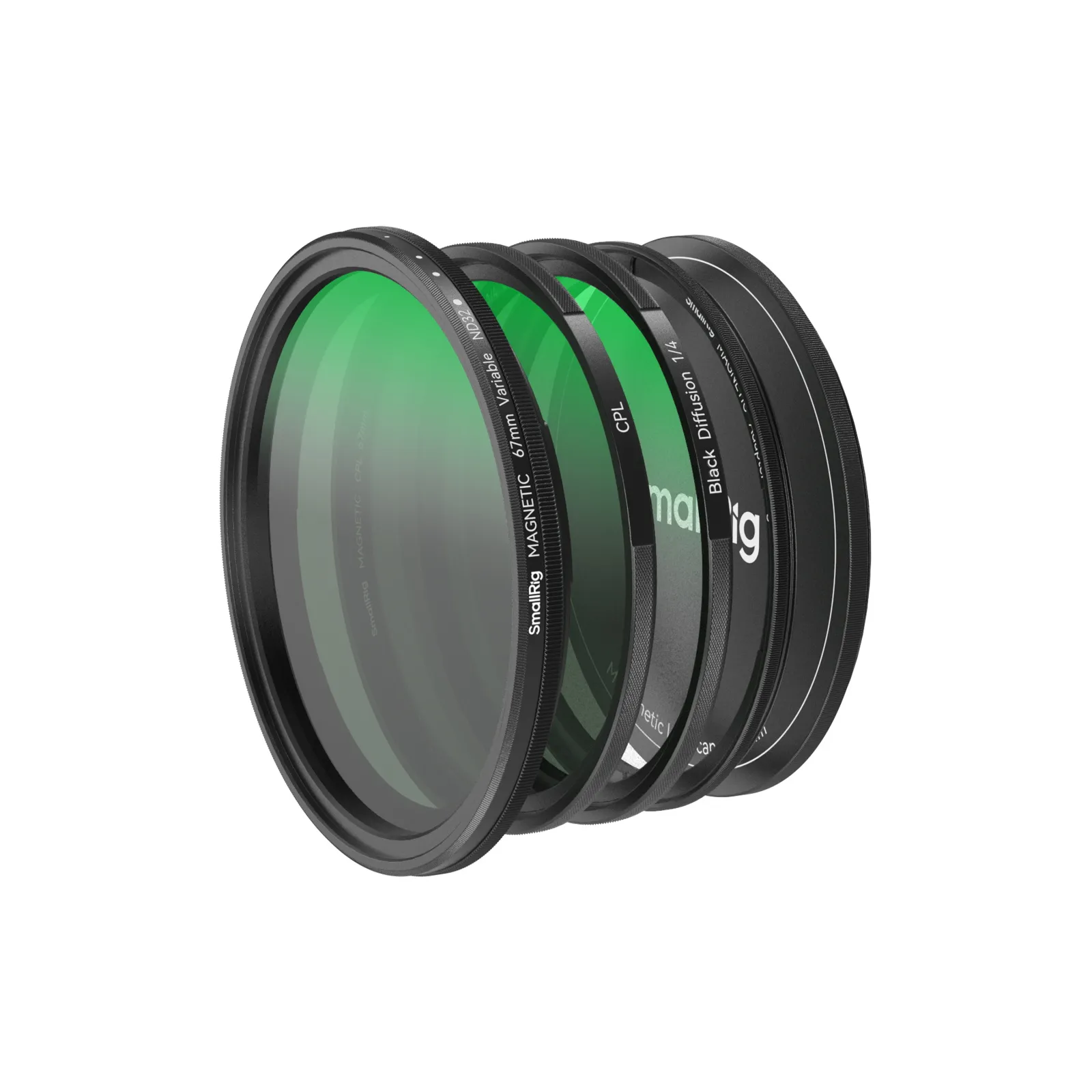
Instead of purchasing separate filters and holders individually, creators can opt for the SmallRig Filter Kit with Adjustable Clamp, compatible with 67–82mm lenses. It integrates CPL, VND, and black mist effects with magnetic quick-release design, eliminates VND X-pattern artifacts, and delivers vignette-free performance even on wide-angle lenses starting at 16mm.

For users creating with both cameras and smartphones, the 5-in-1 Magnetic Attachable 67mm Lens Filter Kit is an excellent all-in-one option, featuring ND2–32 variable density, CPL, and 1/4 black mist filters. It fits SmallRig phone cages and standard 67mm camera lenses, adopts German optical glass with multi-layer nano coatings, and supports magnetic fast mounting for daily photography, travel videography, and cinematic-style creation.
Summary
CPL and ND filters serve two distinct creative purposes:
-
CPL focuses on eliminating polarized glare, suppressing unwanted reflections, and enhancing sky depth and color performance
-
ND delivers uniform light reduction to enable long exposure and wide-aperture shooting under strong light
Neither filter is inherently better — only more suitable for your current shooting scenario.Next time before heading out to shoot, ask yourself: do I need to fix reflection issues, or solve overexposure with slower shutter speeds? The answer will tell you exactly which filter to bring.
Keep Reading
 SmallRig S70 Wireless Mic Review: Best Budget Option?
 How to Take Photos and Vlogs Alone in Public Without Feeling Awkward
 How to Choose a Microphone for Live Streaming