
Search smallrig.com...


Best Camera Microphone 2024: Types and Specs Exploration
SmallRig 2024-04-02 23:52:09
What makes high-quality videos? The answer is quite obvious, that is, the seamless collaboration of captivating visuals and premium audio. Sometimes, the charm of audio can be so overwhelming that it leads to the emergence of ASMR content.
Therefore, investing in the best camera microphone is paramount, whether you are a seasoned filmmaker or an aspiring vlogger. In this article, we will delve into the camera mic's different types and their essential specifications to help you choose the best mic for your camera.
Different Types of Camera Microphones
- Shotgun Microphones
The first camera mic type we will discuss is the shotgun microphone. They are extremely directional, making them ideal for capturing audio from a specific source while rejecting background noise. They are often used in press conferences and sporting events and are usually attached to a long boom pole or atop a camera. However, they may not be the best choice for people who want to capture ambient sounds and they require precise aiming for optimal performance.
- Lavalier Microphones
Lavalier microphones, also called lav mics or lapel mics, are the second we will mention. These small camera microphones can be clipped onto clothing, providing hands-free operation and natural sound reproduction. Their portability makes them ideal for moving persons, like the presenters pacing back and forth and content creators who are city walking. The thing is, you need to position them in a proper place, or you might catch undesired noises from clothing rustling.
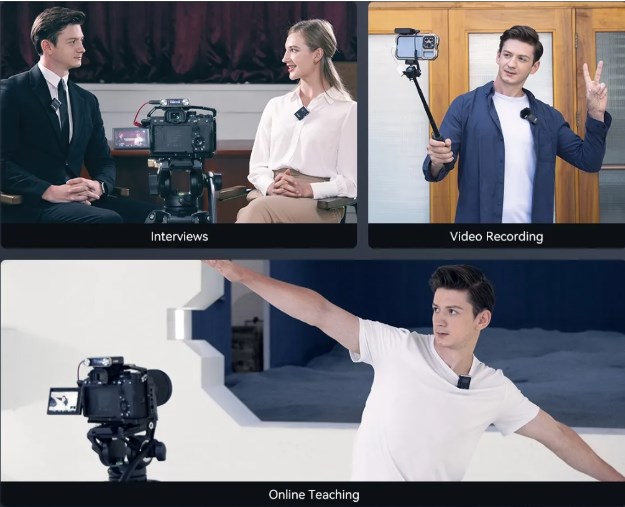
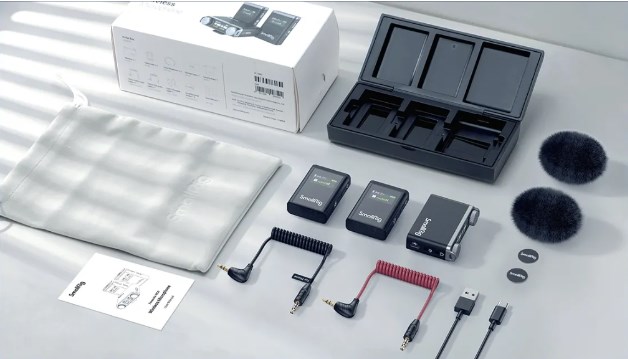
If you are not a fan of tangled cables, you can go directly to the wireless mic for the camera. They include transmitters attached to the microphone and a receiver connected to the camera. What requires your consideration is their operation range and typical duration on a single battery charge. Normally, wireless microphones can operate within a range of 50 to 200 meters and most of them can run for roughly 5 hours of continuous use.
Knowing these different types of camera mics is the first step to the best camera microphone for your needs. Next, we will explore critical specs to help you identify good camera mics.
Specs to Consider When Choosing the Best Camera Microphone
- Microphone Sensitivity
Sensitivity measures the camera mic's efficiency in converting sound pressure into electrical signals, typically measured in mV/Pa (e.g., 50mV/Pa) or dBV/Pa (e.g., -40dBV/Pa). Higher sensitivity implies that the microphone is more responsive to sound, capable of capturing faint sounds and louder ones.
But does it mean the best camera microphone has the highest sensitivity? Not really. When the sound source is distant from the camera mic, a higher-sensitivity microphone can accurately and clearly pick up the sound. Meanwhile, a lower-sensitivity camera microphone can help reduce environmental noise when the sound source is close to the mic.
For instance, low-sensitivity camera microphones are better for capturing your vocals in noisy environments (such as live music venues) and high-pressure level sound sources (e.g., some playing instruments). High-sensitivity camera mics are ideal for catching nature sounds and high-frequency sound sources (e.g., voice-over work).
- Microphone Frequency Response
Microphone frequency response assesses how a microphone responds to a range of frequencies, representing its ability to capture sounds in a specific frequency spectrum. While many camera mics operate within the 20-20,000Hz range, some may be confined to narrower segments within the audible spectrum.
For instance, a camera mic with a frequency response spanning from 40Hz to 15kHz can effectively reproduce sounds in that range. But that's not the whole story, as microphone sensitivity may fluctuate across different frequencies. Therefore, if you seek the best camera microphones for some specific purpose, you can refer to the frequency response graph for a complete overview.
- Microphone Directionality
Mic directionality refers to a microphone's ability to detect sound from different directions, generally falling into three main types:
- Omnidirectional Camera Microphone:
They pick up sounds evenly from all directions, ideal for capturing ambient sounds, such as the natural sounds of a waking wilderness. However, for targeted sound capture, they may not be the optimal choice.
- Unidirectional Camera Microphone:
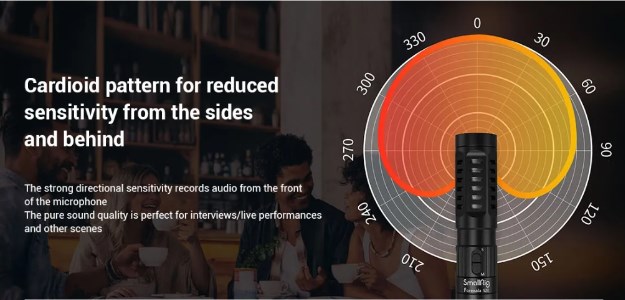
These camera mics mainly catch sounds from one direction, including cardioid and supercardioid mics. Cardioid microphones prioritize front-facing sound, with some side sound pickup, while supercardioid mics are more directional, minimizing most side and rear sounds.
- Bidirectional Camera Microphone:
Just as the name suggests, bidirectional mics pick up sound from two opposite directions. They are often used to record conversations between two individuals facing each other.
- Impedance and Signal-to-noise Ratio
Another important spec is the microphone impedance, which measures the mic's opposition to an AC current (the audio signal). Low-impedance microphones (typically below 600 ohms) are more common due to their ability to resist signal loss over long cable runs and compatibility with a wide range of audio equipment. High-impedance microphones (typically above 10,000 ohms) are less common in professional applications due to their susceptibility to interference and signal loss over long cables.
One more spec for you is the signal-to-noise ratio (SNR), which is usually expressed in decibels (dB). This time, different from the sensitivity, the best camera microphone comes with a higher SNR, as it ensures the recorded audio is of high quality with minimal unwanted noise. In most cases, you can go for camera mics with an SNR of 60 dB or more.
- Additional Features:
Want to improve the performance of your best camera microphone to the next level? You may need some other features, like:
- Windscreen or Windshield: A foam or fur cover that fits over the microphone's diaphragm to reduce the impact of wind noise during outdoor recording.
- Low-Cut Filter (High-Pass Filter): A switch or dial that attenuates frequencies below a certain cutoff point, typically used to reduce rumble, handling noise, or low-frequency interference.
- Variable Gain Control: Allows users to adjust the microphone's sensitivity to incoming sound, enabling precise control over input levels.
-
SmallRig's Best Camera Microphones for You!
Here at SmallRig, we offer 900+ products, including top camera mics. Below is a brief graph of some of our best camera microphones!
Specs
Models
Forevala W60 Wireless Microphone
Forevala S20 On-Camera Microphone
Forevala L20 Lavalier Microphone
Sensitivity
-81dB
-38dB
-38dB
Frequency Response
2400-2483.5MHz
50Hz-20kHz
50Hz-20kHz
Directionality
Omnidirectional
Cardioid
Omnidirectional
Impedance
2.2kΩ
SNR
70dB
70dB SPL
Additional Features
8-hour battery life
100m working distance (Barrier-free)
Dual-channel, Hi-Fi Sound
Plug-and-play design
Shock mount with high compatibility
Furry windscreen
High-density foam cover
Low-cut filter
Gain control
One-touch transition
Long working time (up to 24 hours)
Application Scenarios
Interviews, video recording,
online teaching, live streaming, etc.
Live performance, short video creation,
single/multi-person interview, etc.
Live streaming, interviews,
conferences & lectures,
live performances, etc.
Conclusion
Overall, the importance of camera mics cannot be overstated, which requires the best camera microphone for better audio recording. We've explored different types of camera mics and their specs, which need your consideration. Hopefully, you now have a better idea of the perfect mic for your camera.
Also, SmallRig offers different camera gear for captivating visual capturing and recording, including camera cages, tripods, and v-mount batteries. Moreover, we can tailor devices according to your needs with our "User Co-design" mode and DreamRig free customization project. Trusted by 2M+ customers, we can be your ideal place to fulfill any possibility!
Keep Reading
 71" Camera Tripod 3935: A Quick Guide to Mastering Versatile Shooting
 A Complete Guide to Using the SmallRig 78" Camera Tripod 3474C
 How to Connect the Wireless Control Handle 4329 with the Follow Focus Motor 4297
Related Products from SmallRig